Designing for Decision: Improving Booking Efficiency on Airbnb
Applying UI/UX design to streamline Airbnb’s trip planning flow to reduce decision fatigue.
Project Type
UIUX Design
Team
Atisha Kudesia, Fiona Szeto
Tools
Figma, Figjam
Date
2 months (March 2025 - May 2025)

Overview
Problem
Decision Fatigue During Booking
Users often face decision fatigue and abandon the booking process due to an overwhelming number of options and unclear spatial context.
Solution
A Comparison Tool to Support Better Decision Making
A redesigned UI/UX featuring an in-depth comparison tool paired with an immersive map view to support easier, more confident decision-making.
Impact
Improved Clarity and Alignment with User Booking Behavior
Positive feedback on reduced cognitive load, with an interface that better aligned with user expectations and decision-making flow.
The Process
Background
Trip planning involves several key decisions: destination, travel companions, duration, and accommodation preferences.
For this project, the planning phase begins when a user accesses Airbnb.com or opens the Airbnb app and ends when they decide on a place to stay.
Goals
Reduce decision fatigue by organizing complex information in a more digestible and interactive format.
Simplify the booking journey by streamlining filters, reducing clutter, and highlighting what matters most to each user.
Section 01.
Research
User Persona
We focused on honeymooners, couples planning a once-in-a-lifetime trip with high expectations. They’re meticulous, criteria-heavy planners who compare listings carefully and make joint decisions.
On the persona spectrum, they represent those with the most detailed needs, making them ideal for stress-testing the design’s accessibility and flexibility.

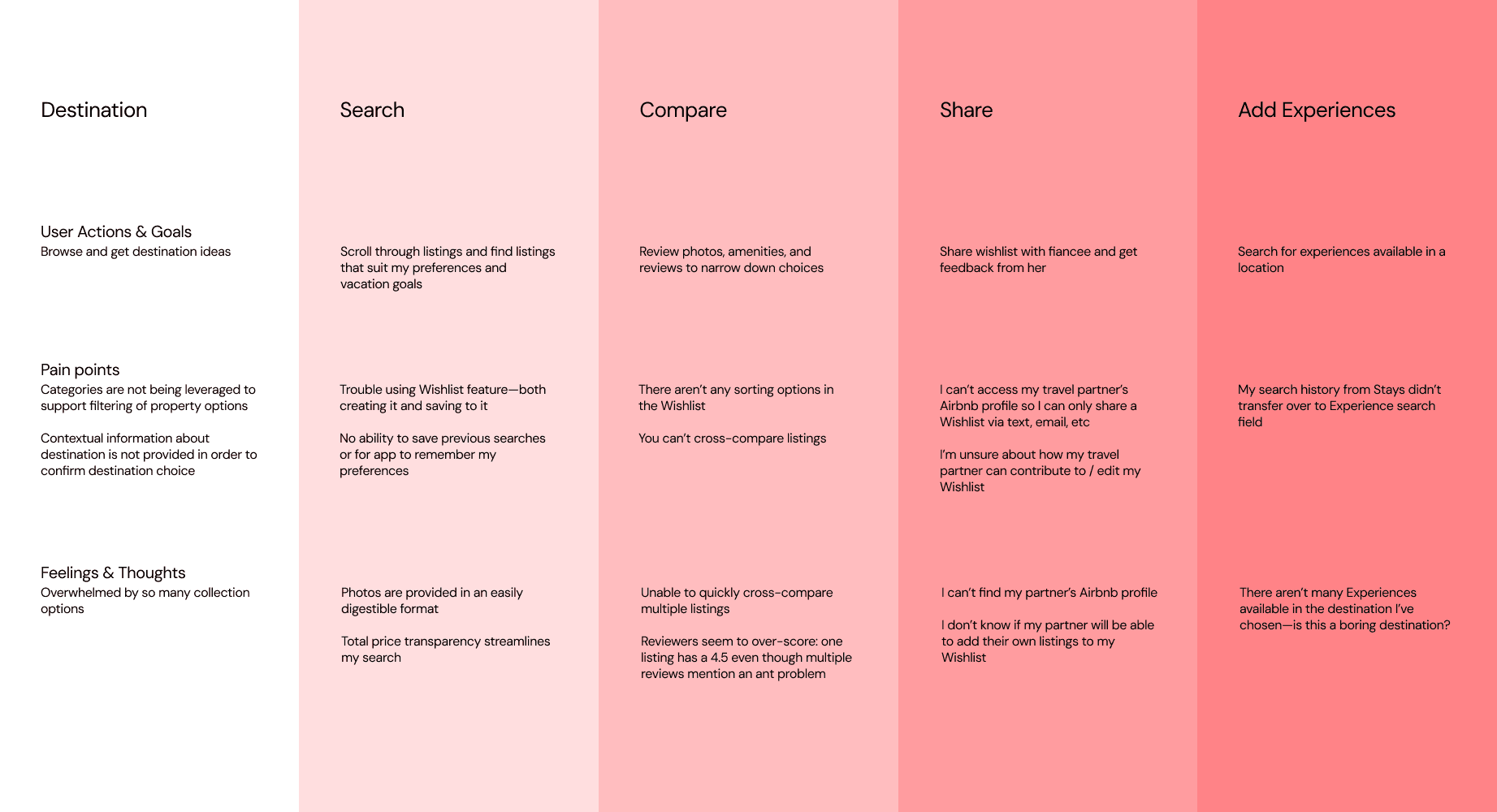
User Journey
Section 02.
Ideation & Design
Problem Framing
Introduction to Thoughtful Execution Framework
The Thoughtful Execution Framework is a structured way to move from goals to impactful solutions. Our team used this framework to explore multiple problems and hypotheses based on data and insights. It helped us ensure that the solution addresses the right problem and that ideas are thoughtfully evaluated before being tested, built, and shipped.

Ideation
Impact vs Complexity

Finalized Solutions

Lo-fi Wireframes


Section 03.
Testing & Iteration
Goals
To gain a better understanding of:
Parameters users consider while comparing multiple listings
Parameters users prioritize when searching for a listing
Pain points that prevent users from making a decision
Methods & Materials
Recruitment
We recruited 5 participants who fit our screener criteria.
Research Plan
(View Research Plan)
Screening Criteria
We designed a short form to identify testers whose travel habits aligned with our product goals.
(View Screening Plan)
Discussion Guide
We conducted 30-minute remote interviews to evaluate early travel booking prototypes.
(View Guide)
Insights to Iterations
01.
Users Prioritize Price, Reviews, and Visual Clarity
Travelers make decisions based on price first, followed by high ratings and user reviews. Visual cues like photos and tags (e.g., “Guest Favourite”) help them quickly assess options.
We refined the information architecture to spotlight essential decision-making elements—like price, rating, and standout tags—making it easier for users to scan and shortlist stays.


02.
Misaligned Booking Flow Causes Friction
Users expected a familiar flow: Filter → Wishlist → Compare. Deviating from this pattern created confusion and interrupted their decision-making process.
Moved Comparison to Wishlists to Match User Workflow
We relocated the comparison feature to the wishlist section, aligning the experience with users’ natural booking rhythm and reducing cognitive friction.

03.
Location Context Matters More Than the Map Itself
For users who valued location, maps alone weren’t enough. They craved richer context—neighborhood safety, food spots, nearby attractions, and transport links.
Added Location Context to Maps for Smarter Booking
We enhanced the maps interface with hover-based previews and overlays that surface context like restaurants, attractions, and transit—supporting more informed location-based decisions.

