UX Research & Design Strategies for Starbucks
Bridging the Digital and Physical to Enhance Customer Experiences
Project Type
Design Research & Strategy
Team
Fiona Szeto, Naomi Shah, Elyanna Blaser
My Role
UX Researcher, Design Strategist
Contribution
Led interviews, insight synthesis, and final strategy recommendations
Tools
Figma, FigJam, Zoom, Otter.ai, Google Docs
Date
Oct-Dec 2024

Overview
Problem
Loss of Starbucks' Community-Centered Identity
Its rapid growth has led to an experience that feels overwhelming, transactional, and rushed, diminishing the brand’s original sense of community.
Solution
Design Strategy Recommendations Based on Desirability, Feasibility, and Viability
We proposed three strategies focused on celebrating unique local culture, separating digital and physical experiences, and including soft friction to restore Starbucks’ warmth community house identity.
Impact
Strategic Design Thinking in Real-World Systems
This project strengthened my ability to design within real-world complexity, balancing business needs, user needs, and brand identity. I gained hands-on experience translating research into feasible, human-centered strategies. Most importantly, I learned how to frame design not just as interface work, but as a tool for shaping behaviors, environments, and long-term connection.
The Process
Background
As part of a research-led initiative, we investigated how Starbucks’ evolving service model impacts its identity. And how to balance the digital and in-person experiences to re-establish Starbucks’ community-centered Identity.
Design Challenge
Starbucks’ digital expansion had weakened its community-centered identity. Our challenge: how might we balance the in-person and digital experiences to help reestablish Starbucks as a community coffeehouse?
Goals
Understand the current trends and future of community building.
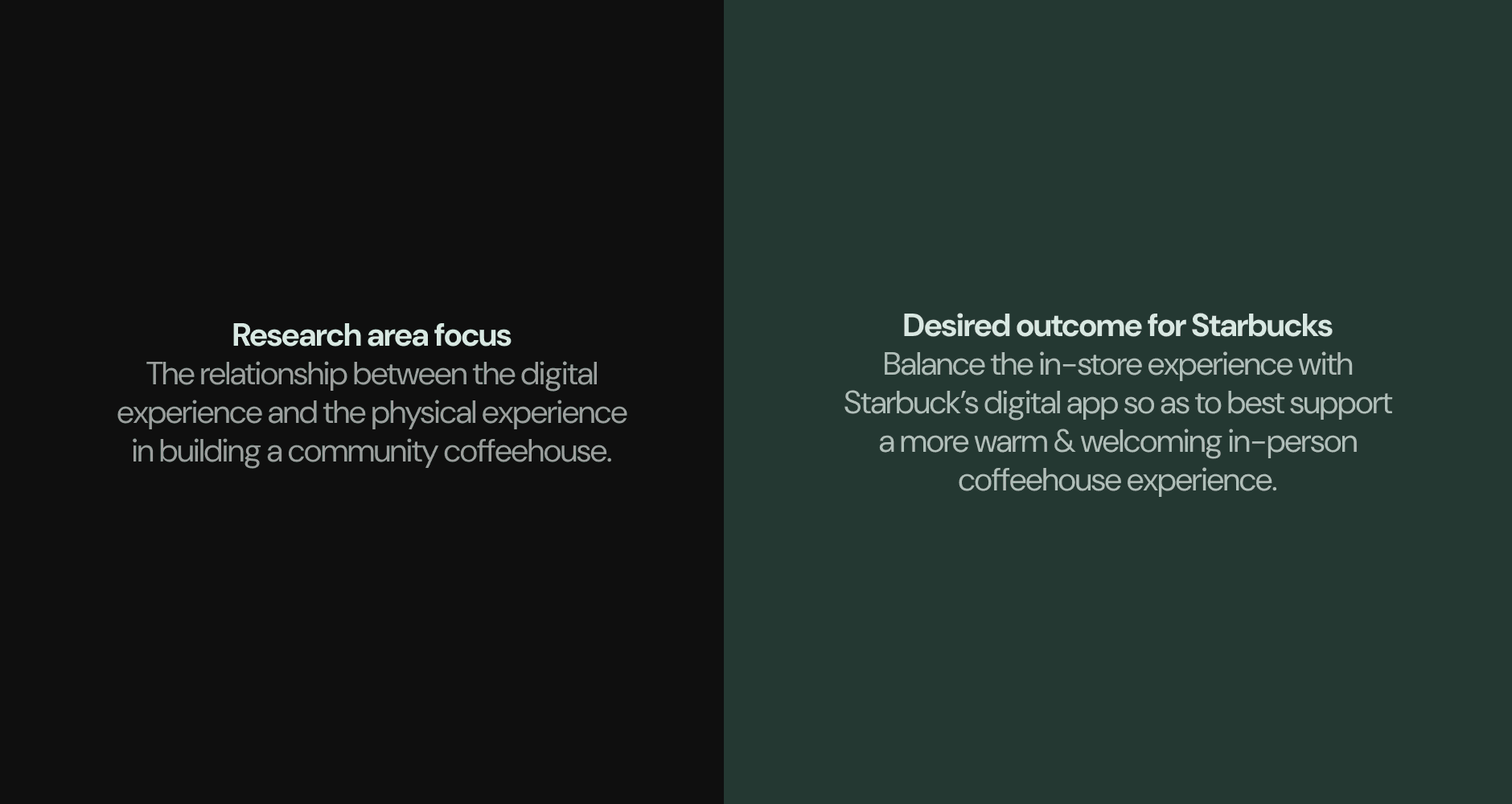
Explore the relationship between digital and physical experiences in supporting a community coffeehouse.
Recommend strategies to restore Starbucks’ identity as a third place for community.
Section 01.
Research
Research Area Focus
Methods
2 User Interviews

2 Diary Studies

4 Expert Interviews

User Highlights

User interview and snapshot of Brooklyn

Diary Study of Prinny
Key insights
Digital removes friction, but friction creates community.
While digital tools offer speed and convenience, they can also lead to isolation. To rebuild meaningful connection, we need digital experiences that don’t replace the physical but guide people back to it.
People are shifting toward smaller and authentic communities.
In the aftermath of digital fatigue and cultural overload, individuals are finding meaning in micro-communities built around shared identity, stories, or values.
Coffeehouses are spaces that can adapt to the experiences people seek.
Some seek a space for productivity, some crave a social atmosphere to share food and connection, and some look for spaces that reflect authenticity, creativity, or local personality. The best coffeehouses adapt to multiple roles, offering both functional and emotional experiences.
How Insights Shaped Direction
Taking these insights together, we saw how community building, digital presence, and coffeehouse experience are deeply interconnected. This led us to design recommendations that integrate all three to create a more holistic vision for how Starbucks can re-establish its coffeehouse identity.
Section 03.
Outcome
Design Strategy Recommendations
Recommendation 01
Celebrate the unique local culture of each Starbucks location through its interiors, app, and social media presence.
Desirability
Users desire to feel personally connected to the space itself through the space’s specific personality.
Feasibility
This strategy might not extend to every single Starbucks location, but can be focused on urban areas to create locally-specific spaces.
Viability
This design shift towards more varied and expressive interiors will bring back customers who have come to see Starbucks as cold and corporate in recent years.

0
10
Recommendation 02
Physically separate the digital to-go experience from the to-stay experience.
Desirability
Users want to feel that the space has been intentionally designed for them to stay, and are fully welcomed by face-to-face interaction with baristas.
Feasibility
The two workflows—to-go and to-stay—will be separated both in terms of both physical space and staff. Flexibility in re-assigning baristas depending on demand would be a point for consideration.
Viability
Customers will want to linger longer in the space. Customer loyalty will increase as users become more attached to the experience through the rituals of human and physical interaction.

0
10
Recommendation 03
Be open to moments of soft friction that encourage longer engagement within physical spaces.
Desirability
Physical interactions, by nature, have friction. And despite the added difficulty, they are still sought after because the payoff is more rewarding. Effort and feeling of connections are directly proportionate.
Feasibility
Can be easily applied as a guiding principle throughout the entire experience (e.g. queues and baristas' interactions).
Viability
Starbucks will be able to point to more sustainable growth in their customer base because customers that make it through these moments of soft but warm friction will become loyal and long-term customers.

0
10
Next Steps
Explore Location-Based Personalization
Investigate how physical spaces and app features can reflect local culture to create more meaningful, community-rooted Starbucks experiences.
Design In-Store Flow to Support Dine-In & Social Connection
Create and test a separate in-store experience flow for dine-in vs. to-go customers to reduce isolation and foster interaction.
Research Barista & Customer Dynamics
Understand how barista satisfaction and users' app usage behaviors shape emotional connection and perception of the space.
Reflection & Learnings
Rethinking Friction as a Design Tool
Friction and efficiency are opposite forces in design. While efficiency is valued for business, friction, when thoughtfully placed, can build connection. I learned that efficiency can undermine community when it removes the moments, like waiting and talking, that make people feel seen. This principle now guides how I design for any system involving people and interaction.
Balancing Desirability, Feasibility, and Viability
Proposing meaningful solutions required me to constantly weigh user needs (desirability), technical and spatial constraints (feasibility), and business objectives (viability). This balance pushed me to think more strategically and design solutions that satisfy users needs but also scale in a real-world setting.
Translating Expertise Knowledge into Actionable Insights
Interviewing experts gave us a wealth of ideas, but the real challenge and learning was in translating their knowledge into insights relevant to our problem space. This process sharpened my ability to listen deeply, reframe information, and extract principles that could guide focused, context-aware designs.